

Beyond Wool: OFDA4000 vs Traditional Testing – Save Time with Optical Analysis
- design6507
- Dec 5, 2025
- 5 min read
Introduction
Demand for faster, more accurate wool testing is rising across the supply chain. The OFDA4000, an Optical Fibre Diameter Analyzer developed by Robotic Vision (OFDA) brings automated imaging and analysis together to streamline laboratory workflows for tops and slivers. Traditional methods such as projection microscopy, Laserscan and Almeter have served the industry well but can be slower and more labour-intensive. This post explains where the OFDA4000 fits, how it works, and when optical automation can save time without sacrificing rigour. (Woolwise)
Explore the benefits of OFDA4000 for your lab workflow see product details. (OFDA)
Key takeaways
Automated optical analysis (OFDA4000) measures fibre diameter, length/true length distribution and curvature in one workflow, reducing manual handling. (Woolwise)
Traditional methods (projection microscope, Laserscan, Almeter) are IWTO-recognised but often require more preparation, skilled labour and longer turnaround. (Woolwise)
Standards alignment: OFDA methods are covered by IWTO-47 (diameter by OFDA) and IWTO-62 (true length & diameter in tops/slivers by OFDA4000). (OFDA)
Decision speed: Optical automation supports faster, more consistent grading and pricing decisions, particularly when processing large batches. (Woolwise)
Content list
What Is the OFDA4000 and How Does It Work?
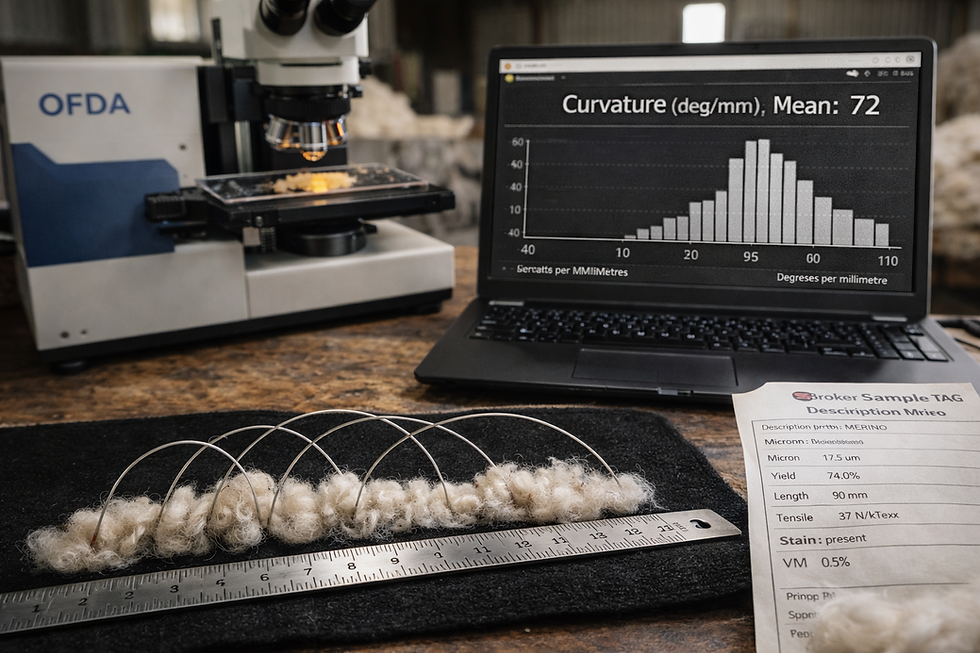
OFDA stands for Optical Fibre Diameter Analyzer. The OFDA4000 uses a machine-vision system to directly image fibres and automatically measure multiple parameters fibre diameter distribution, true fibre length distribution in tops/slivers, diameter profile and fibre curvature within the same run. It automates sample handling and analysis for research and mill laboratories. (Woolwise)
Unlike older capacitive methods (e.g., Almeter hauteur estimation), the OFDA4000 measures true length optically, providing accurate short-fibre content rather than inferred hauteur. It is compatible with IWTO-62, which specifies true length distribution and diameter measurement for wool tops and slivers using OFDA. (OFDA)
Looking to streamline fibre testing? Contact us for a demo of the OFDA4000 in action. (OFDA)
Note on portability: The OFDA4000 is a lab instrument designed for automated, high-throughput analysis. For in-shed, field-portable testing, see OFDA2000, which delivers real-time results for growers and classers. (OFDA)
Traditional Wool Testing Methods: A Time-Consuming Process
Projection microscope, Airflow, Laserscan (Sirolan Laserscan) and Almeter are long-standing IWTO-recognised approaches for wool measurement. They remain important for certification but can involve more intensive sample preparation, skilled operation and longer lab turnaround compared with automated optical workflows. (Woolwise)
Laserscan (IWTO-12): Measures fibre snippets by laser with minimal preparation; widely used for certification of raw wool diameter in Australia, South Africa and New Zealand. Turnaround depends on lab volume and logistics. (CSIROpedia)
Projection microscope (legacy standard): Less accurate and more labour-intensive; operator time and subjectivity can influence throughput. (Woolwise)
Almeter (IWTO-17): Provides hauteur (an inferred length parameter) rather than true length; still used for length characterisation in topmaking. (Woolwise)
OFDA4000 vs Traditional Testing: Head-to-Head Comparison
Feature | OFDA4000 | Traditional Testing |
Speed | Automated imaging and multi-parameter analysis support rapid results in a single run. | Multiple instruments/steps (e.g., separate length and diameter tests) can extend turnaround. (Woolwise) |
Accuracy/Consistency | Direct optical measurements of diameter and true length; reduced operator dependency. | Manual microscopy and inferred length (Almeter) increase reliance on operator technique and assumptions. (OFDA) |
Portability | Laboratory system for high-throughput analysis. | Field testing requires different tools; projection microscope/Almeter are lab-based. For field work, OFDA2000 is used. (OFDA) |
Efficiency | Batch testing with automated handling; diameter, length and curvature captured together. | Separate tests/instruments and manual prep add handling time and cost. (Woolwise) |
Standards Alignment | Compatible with IWTO-62; OFDA diameter method covered by IWTO-47. | Laserscan covered by IWTO-12; Almeter by IWTO-17. (OFDA) |
Pro Tip: During peak shearing and combing, automated optical testing helps labs avoid bottlenecks by capturing multiple metrics in one pass ideal when large batches of tops or slivers must be cleared quickly. (Woolwise)
Key Benefits of Using Optical Fibre Analysis Tools Like OFDA4000
Time savings: Multi-parameter data (diameter, true length distribution, curvature) in one automated workflow accelerates decision-making. (Woolwise)
Enhanced accuracy & consistency: Direct optical measurement reduces reliance on inferred parameters (e.g., hauteur). (OFDA)
Objective data for quality grading: IWTO-aligned methods support consistent grading and trading. (OFDA)
Better market outcomes: Verified, standardised metrics help align specifications with buyer requirements. (Inference based on standards adoption; see IWTO/SGS notes on certification methods.) (SGSCorp)
Use Cases and Global Adoption
Tops and slivers laboratories: Simultaneous diameter and true length distribution is particularly valuable for worsted topmaking and research. (Woolwise)
Standardised trade: Many certification pathways reference IWTO methods (e.g., IWTO-12, IWTO-47), supporting global comparability of results. (SGSCorp)
Industry practice: OFDA technology has been evaluated against Laserscan and Almeter in multi-lab trials and research comparisons, supporting its suitability across a wide fibre diameter range. (SGSCorp)
Why Upgrade to OFDA4000 Now?
Modern supply chains expect faster, verifiable metrics. By automating imaging and analysis, OFDA4000 helps laboratories shorten cycle times and capture richer datasets for classification and pricing without abandoning IWTO-aligned practice. For in-shed decisions, pair the lab-based OFDA4000 with the portable OFDA2000 to cover field and lab needs. (Woolwise)
Ready to transform your fibre analysis? Reach out to our team to see how OFDA4000 fits into your workflow. (OFDA)
Conclusion
The wool industry needs speed, accuracy and efficiency. The OFDA4000 delivers automated, optical measurements of diameter, true length and curvature in one workflow, complementing IWTO-recognised methods used across global trade. Don’t let legacy, manual processes slow you down explore the future of fibre analysis today. (Woolwise)
Contact us for a demo of the OFDA4000.
Glossary of Terms
OFDA (Optical Fibre Diameter Analyzer): Imaging-based instrument that measures fibre diameter distribution; variants include OFDA100/2000/4000. (SGSCorp)
OFDA4000: Automated, lab-based OFDA instrument measuring diameter, true length distribution and curvature (tops/slivers). (Woolwise)
IWTO: International Wool Textile Organisation; publishes standard test methods for wool. (member.iwto.org)
IWTO-47: Diameter measurement using OFDA. (OFDA)
IWTO-62: True length and diameter in tops/slivers using OFDA4000. (OFDA)
Laserscan (IWTO-12): Laser-based snippet diameter measurement (Sirolan Laserscan). (CSIROpedia)
Projection microscope: Manual, operator-dependent diameter measurement method. (Woolwise)
Almeter (IWTO-17): Capacitive method reporting hauteur (inferred length), not true length. (Woolwise)
Hauteur: A statistical parameter describing the effective length of fibres in top produced by Almeter. (Woolwise)
Fibre curvature / diameter profile: Additional structural metrics derived from optical analysis. (Woolwise)
FAQ
How accurate is the OFDA4000?
Peer and round-trial evaluations show OFDA technology provides accurate diameter measurements; OFDA4000 adds true length distribution via direct imaging. Multi-lab trials comparing OFDA4000 with OFDA100, Laserscan and Almeter report strong agreement across a wide diameter range (16–36 µm). As with any method, accuracy depends on calibration and adherence to IWTO methods. (SGSCorp)
Can the OFDA4000 be used in remote locations?
OFDA4000 is designed for laboratory settings with automated sample handling. For field or in-shed testing, the portable OFDA2000 provides real-time results for growers and classers. (OFDA)
How much fibre sample is required?
Sample requirements depend on the test protocol (e.g., tops/slivers and the parameters measured). IWTO methods specify sampling and preparation for each technique; consult IWTO-62 for OFDA4000 tops/slivers testing and follow lab SOPs. (OFDA)
How does OFDA compare with Laserscan?
Both are IWTO-recognised. Laserscan (IWTO-12) is widely used for certification of raw wool diameter; OFDA (IWTO-47) measures diameter by optical imaging, and OFDA4000 (IWTO-62) adds true length distribution. Comparative studies indicate good agreement, with some historical discussion on ultrafine ranges and calibration. (SGSCorp)
Reach out to learn more about selecting the right OFDA instrument for your environment.


Comments