

Which fibre diameter measurement method suits Australia: OFDA, Laserscan or Airflow?

Key takeaways
Laserscan is the IWTO-12 reference for mean fibre diameter and distribution, widely used for certification. IWTO Member Area
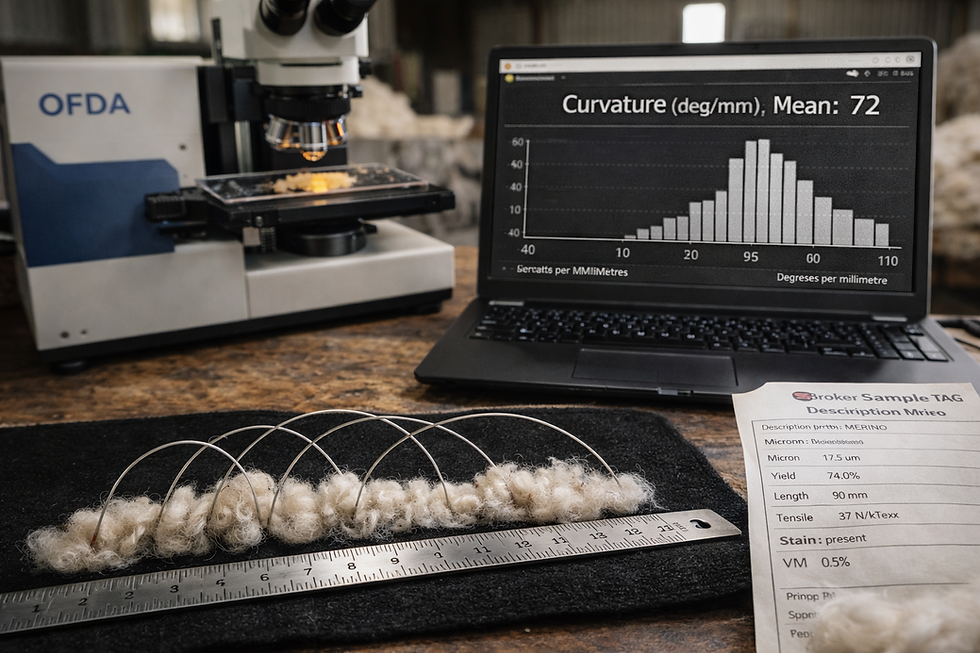
OFDA is covered by IWTO-47 for mean fibre diameter and distribution, and can capture curvature in the same run. IWTO Member Area+1
Airflow provides an indirect mean diameter based on resistance to air flow and is codified for raw wool as IWTO-28. International Wool Textile Organisation+1
Interwoollabs IH Tops underpin calibration for all three methods so datasets are comparable across labs. Interwool Labs
Precision is reported as 95 percent confidence limits from round trials and method stats, guided by ISO 5725 principles on repeatability and reproducibility. Woolwise+1
Content List
Who this guide is for
The three methods in one page
Calibration and reference materials
Precision, confidence intervals and what they mean
Strengths and limits in routine use
Method-by-method detail
Decision framework for Australian labs
Summary
FAQs
Who this guide is for
This decision guide is for wool lab managers who must meet buyer and accreditation expectations while optimising throughput and cost. It focuses on IWTO methods used in Australia and how to choose between OFDA, Laserscan and Airflow when reporting mean fibre diameter and distribution for raw wool, sliver and tops. References cited are drawn from IWTO, Interwoollabs, AWTA and peer reviewed or technical literature. IWTO Member Area+2IWTO Member Area+2
The three methods in one page
Laserscan quantifies mean fibre diameter and distribution via optical scattering and is standardised as IWTO-12. It is the dominant route for certified MFD reporting. IWTO Member Area
OFDA measures diameter and distribution from optical imaging of fibre snippets and is standardised as IWTO-47. Curvature can be captured during the same analysis. IWTO Member Area+1
Airflow determines mean fibre diameter indirectly by measuring resistance to air flowing through a mass of fibres, standardised for raw wool as IWTO-28. International Wool Textile Organisation+1
Comparative industry bulletins report that OFDA and Laserscan agree well on mean diameter for processed wool on average, although methods must not be mixed on a single certificate. SGSCorp+1
Calibration and reference materials
Interwoollabs IH Tops are the common reference set for calibrating Airflow, Laserscan and OFDA. Specific tops are prescribed per instrument family to keep scales aligned and to avoid cross bias, for example using “1AF” for Airflow and “1PM” for optical systems. Robust calibration against IH Tops is central to maintaining agreement between labs. Interwool Labs
Precision, confidence intervals and what they mean
IWTO methods publish precision statements derived from international trials that are expressed as 95 percent confidence limits. In simple terms, the 95 percent confidence limits give the range within which the true value is expected to lie 95 times out of 100 when bias is controlled. ISO 5725 and wool metrology texts explain how repeatability and reproducibility are defined and estimated, and why sampling and preparation dominate the overall variance for wool. AWTA guidance tables illustrate how these limits and maximum retest ranges are used in trade. Woolwise+2ISO+2
Strengths and limits in routine use
Laserscan
Strengths: IWTO-12 certification pathway, strong historical continuity, distribution reporting and curvature availability in aligned practice. IWTO Member Area+1
Limits: Diameter only, separate instruments for length, and optical cleanliness requirements still apply. IWTO Member Area
OFDA
Strengths: IWTO-47 diameter and distribution with high fibre counts per test and curvature available from the same imaging run. Well suited where tops or slivers are also measured under OFDA-based methods. IWTO Member Area+1
Limits: As with any optical system, disciplined snippet preparation and calibration are essential to control bias. SGSCorp
Airflow
Method-by-method detail
6.1 Laserscan under IWTO-12
Laserscan measures the mean and distribution of fibre diameter of wool using an optical instrument designed for certification environments. The method sits at the core of many raw and processed wool reporting workflows in Australia. Independent bulletins note agreement on mean diameter between Laserscan and OFDA on average for processed wool, supporting cross-method comparability when both are correctly calibrated, although results from different methods are not combined on one certificate. IWTO Member Area+2SGSCorp+2
Outputs include mean, standard deviation and full histograms of diameter, with curvature available in aligned practice to help characterise handle and processing behaviour. SGSCorp
6.2 OFDA under IWTO-47
OFDA determines the mean and distribution of fibre diameter by imaging thousands of fibre snippets and converting image widths to microns through calibration. It can record curvature simultaneously from the same images, which many labs find useful when linking diameter variability with handle. IWTO-47 formalises the procedure and precision elements for diameter and distribution using OFDA. IWTO Member Area+1
Comparative work and industry experience show close agreement between OFDA and Laserscan for MFD across normal working ranges, with known systematic differences at the extremes that underline the importance of sound calibration and sample handling. SGSCorp+1
6.3 Airflow for raw wool
Airflow derives mean diameter from the resistance to air flow through a fixed mass of fibres. It is codified for raw wool as IWTO-28, and is part of the standard test portfolio at accredited labs. Because Airflow is an indirect method it does not produce a distribution and relies on calibration against international reference tops that have been measured by baseline methods. International Wool Textile Organisation+1
Decision framework for Australian labs
Use the following three questions to select the most appropriate method for a job.
What does the contract require If the buyer or program specifies IWTO-12, use Laserscan. If the requirement accepts IWTO-47, OFDA is suitable for diameter and distribution and can also provide curvature in the same test. Airflow is valid where IWTO-28 MFD on raw wool is acceptable. IWTO Member Area+2IWTO Member Area+2
Do you need distribution and ancillary metrics Where distribution, histogram shape and curvature are requested, OFDA or Laserscan provide these optical outputs. Airflow is a single value measure of mean diameter. SGSCorp+1
How will you manage precision and risk Build calibration on IH Tops, monitor control charts and report 95 percent confidence limits according to IWTO method precision statements. Apply ISO 5725 concepts of repeatability and reproducibility when comparing instruments and sites, and avoid mixing methods on one certificate. SGSCorp+3Interwool Labs+3Woolwise+3
Rule of thumb
Diameter certification lanes often standardise on Laserscan.
Integrated tops or sliver QC where curvature insight is helpful often favour OFDA under IWTO-47.
Programs focused on economical raw wool MFD for screening may use Airflow, with clear recognition of its indirect nature. IWTO Member Area+2IWTO Member Area+2
Summary
OFDA, Laserscan and Airflow are all valid fibre diameter methods when applied within their IWTO frameworks. Laserscan under IWTO-12 anchors many certification workflows in Australia and reports mean diameter and distribution with optional curvature. OFDA under IWTO-47 reports the same diameter statistics and can capture curvature from the same imaging sequence, which is attractive where labs want richer optical data in tops and slivers. Airflow under IWTO-28 is an economical indirect method for raw wool that yields a single mean value rather than a distribution. Whatever you choose, align the method to contract language, calibrate against Interwoollabs IH Tops and express precision as 95 percent confidence limits consistent with ISO 5725 principles so stakeholders can interpret results correctly. Woolwise+4IWTO Member Area+4IWTO Member Area+4
FAQ
Is Laserscan the IWTO method for certified mean fibre diameter Yes, IWTO-12 defines the measurement of mean fibre diameter and distribution using Laserscan. IWTO Member Area
Which IWTO method covers OFDA diameter measurement IWTO-47 covers the measurement of the mean and distribution of fibre diameter using OFDA. IWTO Member Area
What standard governs Airflow for raw wool MFD Airflow mean fibre diameter for raw wool is specified under IWTO-28. International Wool Textile Organisation
Do OFDA and Laserscan agree on mean fibre diameter Industry trials report good agreement on average for processed wool, with methods not combined on one certificate. SGSCorp+1
How should I express precision in reports Use 95 percent confidence limits derived from method precision statements and ISO 5725 guidance. Woolwise+1


Comments