

On-Farm Testing with OFDA2000: Boost Wool Clip Value
Key takeaways
Objective, real-time data: OFDA2000 measures fibre diameter and distribution on-farm in seconds, enabling decisions during shearing and selection. (OFDA)
Better classing and preparation: Using objective measures (micron, CV, comfort factor) helps build more uniform, market-aligned lines. (awtawooltesting.com.au)
Support breeding choices: Pair OFDA measurements with EBVs/ASBVs to select rams and ewes for target micron and lower variation over time. (Sheep Genetics)
Industry-recognised method: OFDA2000 testing aligns with IWTO-47, the recognised procedure for measuring mean and distribution of wool fibre diameter using OFDA when measuring in clean snippet mode. (member.iwto.org)
Content list
Introduction
What is the OFDA2000 and how does it work?
Why on-farm wool testing matters
Fast, objective results
Improved flock management
Enhanced clip preparation
Optimising breeding with OFDA data
Case study (illustrative): lifting uniformity with portable testing
The ROI of OFDA2000
Getting started on your farm
Future of wool quality: data-driven farming
Final thoughts
Glossary
FAQs
Introduction
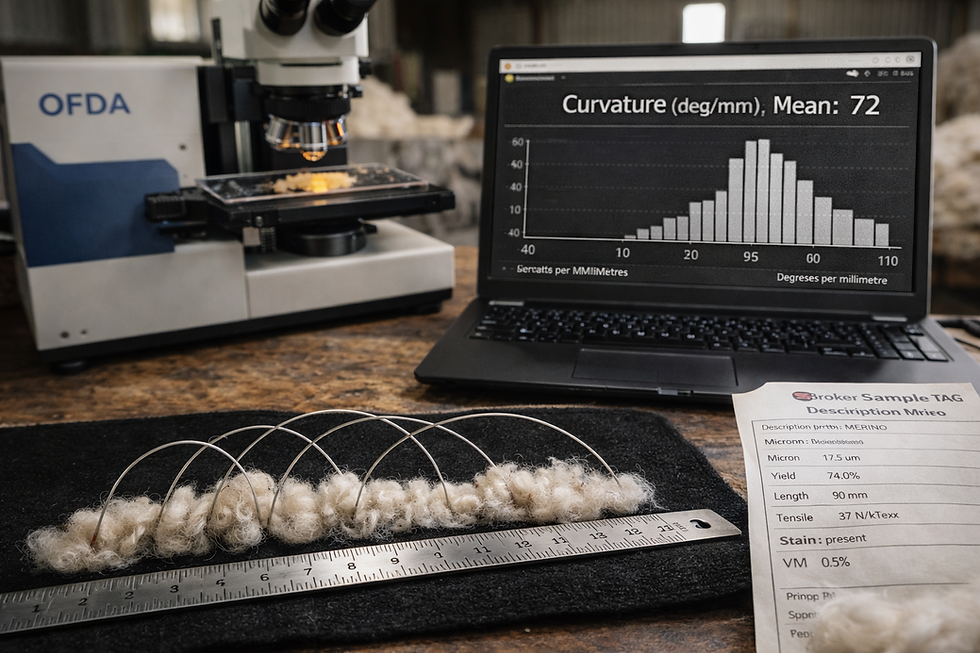
The OFDA2000 is a portable Optical Fibre Diameter Analyser designed to test wool where it matters on the farm. Instead of waiting for lab reports, you can measure fibre diameter and its distribution directly from midside snippets or prepared staple samples and act on the results immediately. Faster, objective testing supports better breeding decisions, clearer classing, and more market-ready clips. (OFDA)
What is the OFDA2000 and how does it work?
OFDA = Optical Fibre Diameter Analyser. The OFDA2000 uses video imaging of fibre snippets moving under a low-power microscope. The instrument detects fibre widths in real time and converts them to diameters via calibration referenced to industry standards. The measurement approach underpins IWTO-47 for mean and distribution of fibre diameter using OFDA. (SGSCorp)
What the OFDA2000 reports (typical outputs):
Mean fibre diameter (µm)
Standard deviation (SD) & coefficient of variation (CV)
Comfort factor (CF; % of fibres <30 µm)
Distribution/percentiles; additional traits may be available depending on setup and workflow (e.g., staple profile). (awtawooltesting.com.au)
The system is portable and fast, thousands of fibres can be analysed within seconds making it suitable for live-animal selection or shed-side classing workflows. (OFDA)
Validation: Peer-reviewed studies have shown OFDA measurements to be closely related to established reference methods for diameter. (pubmed.ncbi.nlm.nih.gov)
Why on-farm wool testing matters
Fast, objective results
During shearing or ram selection, objective measures allow you to act immediately, drafting animals, allocating fleeces, or adjusting shearing order based on measured diameter and variability rather than visual appraisal alone. (OFDA)
Improved flock management
Routine on-farm testing helps identify underperforming or inconsistent animals (e.g., high CV for fibre diameter). Combining OFDA results across years builds a dataset for culling, mating and feeding decisions that target your micron band and uniformity goals. (Sheep Genetics)
Enhanced clip preparation
Objective measurements support classers to tighten line specs and assemble more uniform sale lots attributes that improve buyer confidence. Industry guidance has long emphasised objective measures (micron, length/strength, CV, PoB) as key price drivers. (elearning.mla.com.au)
Optimising breeding with OFDA data
Long-term OFDA records at the animal level (mean, SD, CV, CF) provide phenotypes that complement EBVs/ASBVs for fibre traits such as Fibre Diameter (FD) and Fibre Diameter Coefficient of Variation (DCV). Selecting for finer FD with lower DCV supports production of next-to-skin suitable wool and more uniform clips over time. (Sheep Genetics)
Independent extension materials show that fibre diameter is a major driver of Merino wool price, while selection indexes balance FD with fleece weight, staple strength and other traits. Integrating accurate measurements into genetic evaluation increases the reliability of selection decisions. (Sheep Genetics)
Case study (illustrative): lifting uniformity with portable testing
Scenario (illustrative only): A superfine Merino operation used shed-side OFDA testing across maiden ewes and sale rams for two seasons. Animals with high diameter variability (elevated CV) or out-of-spec micron were re-mated or culled. By the next shearing, the clip showed narrower micron distribution and clearer separation of lines, improving sale readiness. (This scenario is illustrative; outcomes vary with genetics, seasonal conditions and management.)
Why it works: The team combined objective diameter & CV data with ASBVs to keep genetic pressure on their target band while managing environmental effects. (Sheep Genetics)
The ROI of OFDA2000: is it worth the investment?
Return on investment depends on your flock size, price targets, labour and advisory support. Potential value levers include:
Reduced reclassing and rehandles through clearer, measured lines. (woolwise.com)
More precise ram selection using phenotypes that feed into EBVs/ASBVs and selection indexes. (Sheep Genetics)
Operational efficiencies at shearing (e.g., order, drafting and allocation informed by micron/variability data). (woolwise.com)
While hard numbers vary, independent economics consistently link objective measurement with improved decision quality in production and marketing. (woolwise.com)
Getting started with OFDA2000 on your farm
Talk to us: Learn about OFDA2000 configurations, calibration and workflow suited to your shed. (OFDA)
Plan the data flow: Decide how results will integrate with your recording system and how they’ll inform EBV/ASBV use. (Sheep Genetics)
Future of wool quality: data-driven farming
The direction of travel is clear: precision livestock tools (automated weight, feed and fleece phenotyping) are making flock-level data routine. Recent research is even exploring how variation in fibre diameter over time can inform resilience and management decisions. OFDA-based measurements fit naturally within this move to evidence-led decisions. (sciencedirect.com)
Final thoughts
For quality-focused wool growers, on-farm OFDA testing offers practical gains: faster decisions, clearer lines and better alignment with breeding objectives. When paired with ASBVs/EBVs and skilled classing, it’s a robust pathway to more consistent, market-ready clips. (Sheep Genetics)
Ready to integrate objective testing in your shed? Talk to our team about OFDA2000 workflows, training and data integration.
Glossary of terms
OFDA (Optical Fibre Diameter Analyser): Video-imaging instrument that measures wool fibre diameters from prepared snippets; method basis for IWTO-47. (SGSCorp)
IWTO-47: International Wool Textile Organisation test method for mean and distribution of fibre diameter using OFDA. (member.iwto.org)
Comfort Factor (CF): Percentage of fibres finer than 30 µm in a sample’s distribution. (awtawooltesting.com.au)
Coefficient of Variation (CV): Standard deviation divided by mean diameter, expressed as a percentage; lower CV indicates a tighter, more uniform distribution. (General statistical definition; used in wool trait DCV.) (Sheep Genetics)
Medullation: Presence of a hollow or partially hollow core in some fibres; affects appearance and dye uptake in wool/mohair. (SGSCorp)
ASBV/EBV: Genetic value estimates predicting an animal’s merit for traits such as fibre diameter and DCV; used to inform selection. (Sheep Genetics)
FAQs
Q1. How accurate is OFDA compared with lab instruments?
Peer-reviewed studies found OFDA fibre diameters closely aligned with projection microscope and other reference methods for mean and distribution. (pubmed.ncbi.nlm.nih.gov)
Q2. Does OFDA2000 comply with industry standards?
Yes. OFDA2000 testing aligns with IWTO-47, the international method for measuring mean and distribution of wool fibre diameter with OFDA. (member.iwto.org)
Q3. What samples do I need on-farm?
Commonly, midside snippets or prepared staples are measured. Consistent sampling is important; midside is widely used to represent average fleece diameter for EBV/ASBV workflows. (Unlocking the Perfect Sheep)
Q4. Can comfort factor be reported from OFDA data?
Yes. Comfort factor is % of fibres <30 µm, calculated from the measured distribution. (awtawooltesting.com.au)
Q5. How does OFDA data plug into breeding?
Use OFDA phenotypes (FD, CV) alongside ASBVs to select animals toward your micron target and lower variability; indices balance these with fleece weight and other traits. (Sheep Genetics)


Comments