

Beyond Wool: Using OFDA for Hemp, Alpaca and Synthetic Fibres
Key takeaways
OFDA is an optical image-analysis method recognised by IWTO for wool that can be applied to many natural and synthetic fibres with appropriate preparation, delivering rapid, distribution-level metrics (mean micron, SD, curvature). (Woolwise)
Emerging peer-reviewed work shows OFDA’s applicability to hemp and cotton, complementing existing methods used for bast fibres. (tandfonline.com)
In alpaca, objective micron and curvature data support grading and breeding decisions, addressing variability seen with visual assessment alone. Typical mean diameters reported for alpaca are in the low- to mid-20 µm range (population dependent). (tandfonline.com)
For synthetics, laboratories report using OFDA 4000 on many man-made fibres to check diameter and length parameters, aiding consistency in high-performance textiles. (bulmerandlumb.com)
Content list
What is OFDA and why it matters
Using OFDA for hemp fibre testing
OFDA in alpaca fibre measurement
Applying OFDA to synthetics and blends
How OFDA supports sustainable innovation
Industries benefiting from OFDA expansion
Final thoughts
Glossary of terms
FAQ
Introduction: OFDA for non-wool fibres
Optical-based Fibre Diameter Analyser (OFDA) technology is synonymous with objective wool testing. Today, R&D labs, processors and brands are adapting OFDA for hemp, alpaca and synthetic fibres to bring the same speed, repeatability and statistical depth to broader material portfolios. Early and ongoing studies, plus lab practice, indicate OFDA can deliver reliable distribution-level measurements across diverse fibres when samples are prepared correctly. (PubMed)
Want to modernise your fibre analysis process? Talk to our team about adapting OFDA to your material needs.
What is OFDA and why it matters in textiles
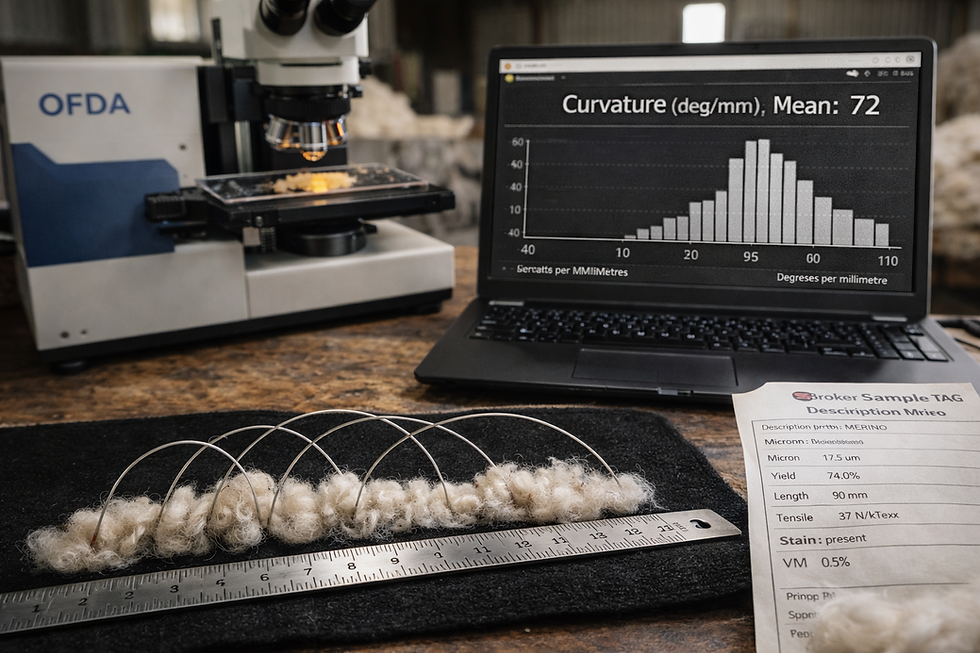
How it works. OFDA uses automated optical imaging and software to measure thousands of fibre snippets, reporting mean diameter, distribution (SD/CV), and curvature metrics central to handle, strength and processing behaviour. It is an IWTO-recognised method for wool (e.g., IWTO-47 for diameter distribution), with documented precision and known calibration requirements. (Woolwise)
Why it matters.
Quality control: objective micron and distribution reduce batch-to-batch variability.
Grading: aligns supply with spec (e.g., comfort factor thresholds for apparel).
R&D: fast feedback for process trials, blends and finishing routes.
Further reading on curvature measurement within OFDA workflows is available from SGS technical bulletins. (SGSCorp)
Using OFDA for hemp fibre testing
Hemp’s mechanical properties depend on agronomy, retting and decortication; objective measurements help tame this variability. Reviews of bast-fibre metrology highlight optical/image-based approaches among recognised methods for characterising fibre dimensions. Recent peer-reviewed work proposes and evaluates OFDA for hemp, positioning it alongside established techniques for fibre width/diameter assessment. (mdpi.com)
Where OFDA helps in hemp:
Micron and distribution: track width uniformity across batches and processing routes. (tandfonline.com)
Process optimisation: quantify effects of retting or enzymatic treatments on fibre fineness. (mdpi.com)
Blend design: generate inputs for spinner settings and cottonisation trials (paired with tensile testing).
An OFDA-style optical workflow complements other characterisation (e.g., tensile strength, length and chemical spectroscopy), providing rapid population statistics to guide QC and R&D. (mdpi.com)
OFDA in alpaca fibre measurement
Alpaca fleece shows wide within- and between-animal variation. Objective testing reduces subjectivity and supports both breeding and commercial grading.
Micron accuracy & distribution: optical instruments such as OFDA correlate strongly with legacy projection microscopy for animal fibres; alpaca populations commonly show mean fibre diameters in the low- to mid-20 µm range, increasing with age. (PubMed)
Curvature tracking: OFDA measures curvature on thousands of snippets during diameter analysis, offering a proxy for crimp style/handle relevant to processing. (SGSCorp)
Uniformity: distribution metrics (SD, CV) support comfort claims and classing consistency.
Breeding or processing alpaca fibre? See how OFDA supports objective micron testing.
Application of OFDA in synthetics and blended fibres
For man-made fibres (e.g., polyester, nylon, acrylic), consistent filament diameter underpins uniform dye uptake, filtration performance and mechanical behaviour. Technical laboratories report using OFDA 4000 to measure diameter and length parameters on most synthetic fibres, providing rapid distribution data useful in process control and for blend optimisation. (bulmerandlumb.com)
Broader technical literature places optical image analysis among accepted approaches for fibre diameter characterisation including natural and synthetic fibres alongside spectroscopic and microscopic techniques used for identification or nanoscale work. (OFDA focuses on geometrical metrics; pairing with FT-IR/Raman can aid identification when required.) (sciencedirect.com)
How OFDA supports sustainable innovation
Less waste, better fits: tight diameter distributions help align fibre supply to spec, reducing off-grade lots and rework.
Data for circular models: consistent metrics aid sorting/reuse decisions and blended-content verification when combined with other analyses.
Transparent sourcing: objective fibre quality data strengthens specification sheets and supplier QA.
(For background on method precision, calibration and environmental controls in optical systems, see wool metrology references.) (Woolwise)
Industries benefiting from OFDA expansion
Sustainable fashion and eco-fibre startups
High-performance outerwear and sports textiles
Interior and technical textiles
Smart textiles and wearable R&D
Defence and industrial fabrics
Final thoughts: the future of fibre analysis
As fibre portfolios diversify, distribution-level measurements micron, SD, curvature become foundational across natural, animal and synthetic fibres. OFDA’s optical pipeline offers the speed and repeatability modern operations need and integrates well with complementary tests (tensile, spectroscopy, chemistry). Active research on bast fibres (hemp, flax) and cotton indicates growing cross-material applicability. (tandfonline.com)
Ready to improve quality, consistency and innovation across fibres? Contact Robotic Vision.
Glossary of terms
AFD (Average Fibre Diameter): Mean fibre diameter of a sample, commonly expressed in micrometres (µm). (PubMed)
Curvature: Degrees of fibre turn per millimetre; an objective proxy for crimp/handle measured alongside diameter in OFDA workflows. (SGSCorp)
Distribution (SD, CV): Statistical spread of diameters that influences handle, processing behaviour and comfort. (Woolwise)
IWTO-47: International Wool Textile Organisation method for measuring mean and distribution of fibre diameter using OFDA (wool). (Woolwise)
Bast fibre: Plant fibre from phloem (e.g., hemp, flax) often requiring retting/decortication; properties depend on processing. (mdpi.com)
FAQ
Is OFDA “wool-only”?
No. While standardised for wool under IWTO-47, OFDA is an optical image-analysis method. Research and lab practice show it can assess other fibres e.g., alpaca, cotton and hemp when prepared appropriately. (Woolwise)
Can OFDA measure curvature in non-wool fibres?
Yes curvature is computed from the same image data used for diameter, provided snippets lay naturally and imaging quality is sufficient. (SGSCorp)
What about synthetic fibres and continuous filaments?
For many synthetics, technical labs use OFDA 4000 to measure diameter and length parameters. For identification or nanoscale features, pair OFDA with spectroscopic or high-resolution microscopy. (bulmerandlumb.com)
What sample prep changes outside wool?
Maintain clean, short snippets, controlled mounting and calibration suited to the fibre type/environment; these factors are known to affect optical measurements. (Woolwise)


Comments