

Flax & Linen Fabric Testing: How OFDA Measures Fibre Diameter, Length & Curvature

Flax has earned its place in modern textiles for performance and sustainability, but consistent linen quality still depends on what’s happening at fibre scale. Measuring diameter, length and curvature tells you how a batch will spin, how a fabric will feel, and how stable a process will be. The Optical Fibre Diameter Analyser (OFDA) was built precisely for this kind of work. It uses optical imaging—not lasers—to capture thousands of fibre measurements quickly and report the full distribution, not just a single average. That combination of speed and statistical depth is why OFDA is trusted across fibres and labs worldwide. OFDA
Why OFDA (and why “how” matters)
Bast fibres like flax vary with variety, retting, scutching and hackling. To make sense of that variability, you need a method that measures lots of fibres, repeatably, and makes the workflow practical in a lab or mill. OFDA’s approach is image-based: a microscope and video system capture fibres; software detects each fibre’s width/shape and calculates metrics in real time. For wool, this method is codified as IWTO-47; the same optical principles are applied when labs adapt OFDA for other fibres, including flax. SGSCorp+1
How OFDA measures fibre diameter
For diameter (micron), fibres are prepared on a glass slide as short snippets. The instrument moves the slide under a low-power microscope; a video camera captures fields of view; software detects each fibre image width and converts those widths to diameter using a calibration derived from industry standard tops. Measuring thousands of fibres per test gives a robust distribution (mean, SD/CV, histogram) that reflects real processing behaviour. On the OFDA2000, throughput can reach up to 20,000 fibres in 25 seconds, reducing operator influence and enabling high-volume screening. SGSCorp+2interwoollabs.org+2
How OFDA measures true length
Length becomes critical once flax is in sliver or top, where short-fibre content drives spinning efficiency and yarn quality. The OFDA4000 automates feed and scanning of fibre arrays from sliver/top and determines true length optically, at the same time it measures diameter. From this it reports the length distribution and short-fibre percentage and can derive Hauteur from the combined length×diameter profile—without relying on assumptions used in older capacitance methods. In practice, this lets mills make data-led calls on cut, combing and blend optimisation. OFDA+2OFDA+2
How OFDA measures curvature (fibre “straightness/shape”)
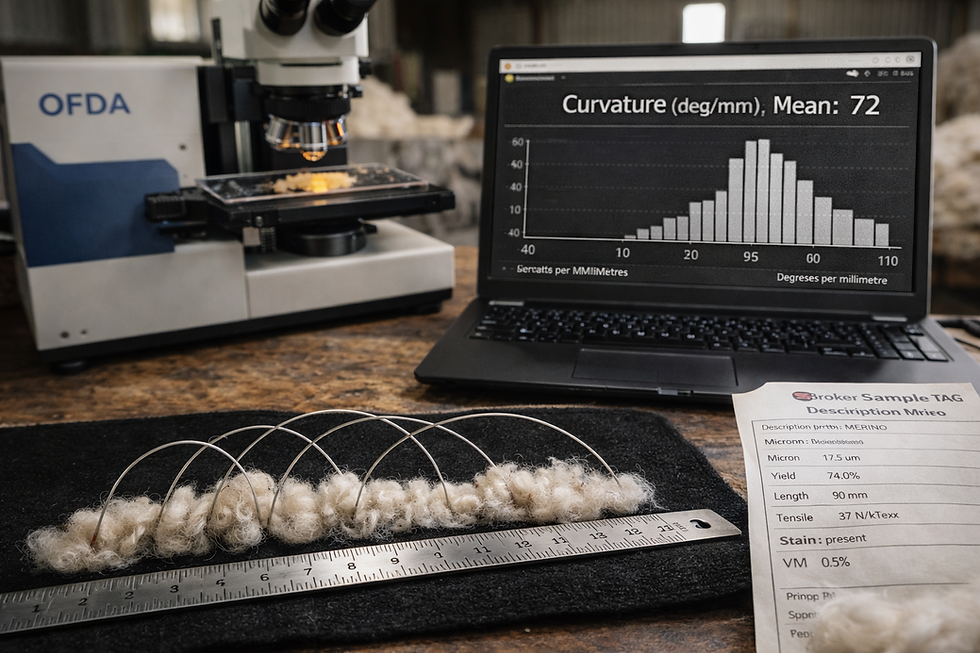
Curvature helps explain handle and drafting behaviour, especially when two lines share a similar mean diameter. During the same imaging used for diameter, OFDA calculates the curvature of each snippet and reports results (commonly in degrees per millimetre, °/mm) as a distribution and mean. The measurement is made on large fibre counts and summarised statistically—so you see whether a batch is notably straighter or more curved than another, and by how much. SGSCorp
Flax-specific sampling: getting prep right
Because flax is a bast fibre, the stalk contains bundles that must be separated into individual fibres before image-based measurement. After retting, scutching and hackling individualise fibres; those fibres are then suitable for OFDA slide measurement of diameter, and for OFDA4000 sliver/top runs where length + diameter are captured together. If a buyer requests permeametric fineness (air-flow) to ISO 2370, that can be run alongside OFDA for a complementary view; just make sure each report clearly states the method so results remain comparable. ISO+1
What OFDA does not do (and what sits alongside it)
Strength and moisture testing are important for flax and linen performance, but they’re separate laboratory methods. In a complete programme, OFDA provides diameter, true length and curvature distributions; tensile and moisture tests are then added as needed for product-specific specifications. Keeping methods distinct helps avoid mixing metrics and improves traceability in production records. OFDA
Choosing between OFDA2000 and OFDA4000
If your priority is rapid diameter distributions on many flax samples—R&D, retting trials, incoming QC—the OFDA2000 is the workhorse: portable, fast and designed for high throughput slide measurements. If your question includes length—sliver/top optimisation, short-fibre control, or research into fines—the OFDA4000 captures true length and diameter in one pass with automated handling that suits routine mill use. Many labs use both: OFDA2000 for breadth and speed; OFDA4000 when length must be part of the decision. OFDA+1
Wrap-up
Flax and linen quality starts with credible fibre data. By imaging thousands of fibres per test, OFDA delivers the distributions that matter—diameter, true length and curvature—with the practicality needed in real production. Align preparation to the fibre form you have, label the method on every report, and you’ll turn natural variability into predictable, repeatable outcomes. OFDA


Comments