

Global Applications: How OFDA is Used in Different Fibre Industries
- Thomas Hegerty
- Dec 26, 2025
- 4 min read

Key takeaways
Wool labs and mills use OFDA under recognised IWTO methods for diameter and, in tops and slivers, true length distribution. member.iwto.org+1
Peer-reviewed alpaca studies show fibre diameter and variability are key selection traits, reinforcing the value of objective distribution data. Frontiers
New research identifies OFDA as a promising high-throughput tool for hemp fibre diameter measurement, supporting textiles and composites work. Taylor & Francis Online+1
Flax characterisation literature highlights how width and length at different scales affect yarn mechanics, where per-fibre imaging and distributions are useful. MDPI
For synthetics and recycled blends, credible chain-of-custody and testing frameworks guide quality and claims, alongside lab systems that profile length and neps. Textile Exchange+1
Content list
Wool
Alpaca
Hemp
Flax
Synthetics and recycled inputs
Standards and methods
FAQ
Wool
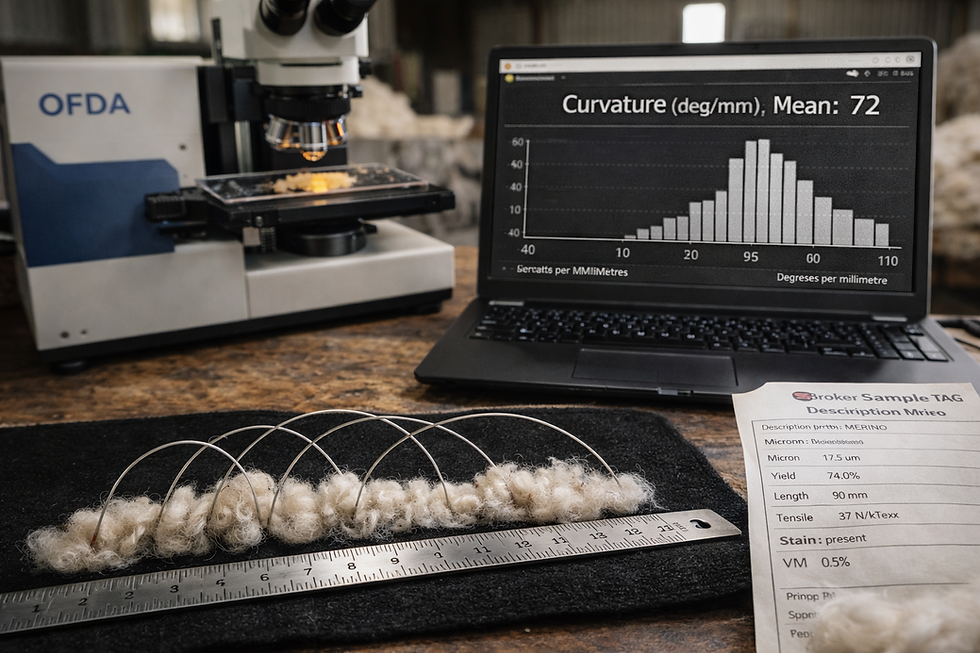
OFDA supports mean diameter and distribution reporting under IWTO-47, and when measuring tops and slivers true length and diameter distributions under IWTO-62. These IWTO methods are used internationally for contract specs, mill QA and independent certification. Practical guidance includes: align sampling to the lot or top break, clearly label scoured/greasy status, and report both central tendency (e.g., MFD) and dispersion (e.g., CV, SD, histogram) so buyers and mills can set combing and spinning windows. Many licensed labs reference IWTO-47 and IWTO-62 in their certificates, supporting traceability and dispute resolution. International Wool Textile Organisation+3member.iwto.org+3member.iwto.org+3
It provides trade clarity by ensuring consistent diameter distributions for pricing. It also supports process control by offering length distribution data in tops and slivers for drafting and twist settings. Additionally, it aids R&D by enabling side-by-side trials on scour and combining effects with matched preparation notes.
Alpaca
Independent research shows alpaca fibre quality is influenced by colour, breed (Huacaya vs Suri), age, sex and location; mean fibre diameter and variability remain central to grading and pricing. Objective, distribution-level metrics from OFDA help breeders and mills: (1) quantify whole-fleece variability, (2) monitor selection response over seasons, and (3) link distribution tails to prickle risk and handle targets. When reporting, state body site and preparation (e.g., midside, shoulder, blanket composite), sample count, and any colour handling, so results are comparable across shows, farms and seasons. Frontiers+2Frontiers+2
It supports breeding decisions by allowing selection for lower mean fiber diameter (MFD) and tighter distributions. It helps product development by aligning micron bands with intended knitwear or worsted specifications. It also enhances transparency by enabling evidence-based dialogue with growers and buyers.
Hemp
Recent peer-reviewed work identifies the Optical Fibre Diameter Analyser as a suitable, repeatable tool for hemp fibre diameter evaluation. This addresses the need for high-throughput measurement as decortication, enzymatic retting and mechanical refining workflows scale. For repeatability, report gauge setting, field-of-view, and any cleaning/treatment steps (e.g., alkaline wash) so datasets remain comparable across lines and labs. Use per-fibre histograms to understand width dispersion, then correlate with composite lay-up performance or carding behaviour. Taylor & Francis Online+2Taylor & Francis Online+2
It facilitates process trials by allowing quick comparisons of retting or cleaning settings through observed diameter shifts. It also supports spinnability checks by highlighting distribution tightening before carding or drawing. Additionally, it aids work with composites by linking width distributions to tensile properties in unidirectional laminates.
Flax
Flax and linen programs benefit from multiscale characterisation linking fibre width and length to yarn performance and composite properties. Literature recommends explicitly stating the structural level measured (elementary fibre vs technical bundle vs yarn) and pairing mechanical tests with distribution-level morphology. OFDA’s per-fibre imaging and width distributions can complement tensile testing and bundle length assessments, clarifying how preparation (scutching, hackling) shifts the tails of the distribution that drive breakage and yarn irregularity. MDPI+2MDPI+2
Yarn optimization matches width distributions to count/structure. Composite design selects feedstock with tighter distributions for consistent stiffness. Methods transparency allows for reproducible reporting across research groups and mills.
Synthetics and recycled inputs
In synthetic staple and recycled blends, controlling diameter and length distributions stabilises spinning and reduces defects. Industry guidance for recycled materials stresses third-party verification and documented chain of custody (e.g., RCS, GRS). Application reports show that nep content and short-fibre levels can shift with recycled inputs; pairing AFIS nep/length profiling with OFDA’s distribution outputs gives a fuller picture for carding, combing and ring-spinning settings. Clearly cite blend ratios, source streams, and any pre-opening steps in reports. rieter.com+5Textile Exchange+5Textile Exchange+5
Quality claims link certified chain-of-custody documents to measured properties. Process windows allow for adjusting draft, twist, and combing based on distribution shifts. Cost control helps detect variability early to minimize off-quality and waste.
Standards and methods
IWTO-47. Measurement of the mean and distribution of wool fibre diameter using an Optical Fibre Diameter Analyser. member.iwto.org
IWTO-62. Determination of fibre length distribution and fibre diameter distribution of wool tops and slivers using OFDA4000. member.iwto.org
Recycled materials frameworks. Textile Exchange’s RCS and GRS set criteria for third-party certification and chain of custody. Textile Exchange+1
FAQ
Is OFDA recognised in wool trade testing Yes. Wool laboratories use IWTO-47 for diameter distributions and IWTO-62 for length and diameter distributions in tops and slivers. These methods are published by IWTO. member.iwto.org+1
Can OFDA support alpaca programs Peer-reviewed studies show the importance of mean fibre diameter and variability in alpaca selection and grading. OFDA supplies rapid, high-count distribution data aligned with these needs. Frontiers
Is OFDA suitable for hemp and flax Yes in research and development contexts. Recent academic work demonstrates OFDA for hemp diameter measurement. Flax literature emphasises rigorous characterisation of width and length, where per-fibre distributions are informative alongside tensile testing. Taylor & Francis Online+2DOAJ+2
How does OFDA fit with synthetic and recycled inputs Distribution measurements help set process windows and monitor recycled blend behaviour. Industry frameworks call for third-party test reports and verified chain of custody. OFDA can operate alongside AFIS in a lab quality program. uster.com+1
Where should a team start when expanding beyond wool Define the decision you need data to support, align preparation to fibre form, label the method clearly in reports, and attach third-party certificates for recycled inputs where required. Textile Exchange


Comments